KC-4871

TMD8-BTK-C481Y-KI Cell Line

×
Please enable JavaScript in your browser to complete this form.
53262
Home » TMD8-BTK-C481Y-KI Cell Line

Background of TMD8-BTK-C481Y-KI Cell Line

Bruton's tyrosine kinase (BTK) is a critical enzyme in the B-cell receptor (BCR) signaling pathway, playing a pivotal role in the development, differentiation, and survival of B-cells. Due to its central role in B-cell malignancies, BTK has become a key therapeutic target for the treatment of chronic lymphocytic leukemia (CLL), mantle cell lymphoma (MCL), and other B-cell-related disorders. The development of BTK inhibitors, such as ibrutinib, has revolutionized the treatment landscape for these diseases, offering improved outcomes for patients. However, the emergence of resistance mechanisms, particularly the BTK-C481Y mutation, has posed significant challenges to the long-term efficacy of these therapies.The BTK-C481Y mutation arises from a point mutation in the BTK gene, where a cysteine residue at position 481 is replaced by a tyrosine residue (C481Y). This mutation occurs within the binding site of ibrutinib and other covalent BTK inhibitors, which typically form a covalent bond with the cysteine residue to achieve irreversible inhibition. The substitution of cysteine with tyrosine disrupts this covalent binding, reducing the affinity of the inhibitor for BTK and leading to therapeutic resistance. As a result, patients harboring the BTK-C481Y mutation often experience disease progression despite ongoing treatment with covalent BTK inhibitors.

Specifications

Catalog NumberKC-4871
Cell Line NameTMD8-BTK-C481Y-KI Cell Line
Host Cell LineTMD8
DescriptionStable TMD8 clone expressing endogenous BTK gene bearing C481Y mutations
QuantityTwo vials of frozen cells (≥2-106/vial)
StabilityStable in culture over a minimum of 10 passages
ApplicationDrug screening and biological assays
Freezing MediumRPMI1640+20% FBS+10% DMSO
Propagation MediumRPMI1640+10% FBS
Selection MarkerNA
MorphologyLymphoblast
SubcultureSplit saturated culture 1:3-1:4 every 2-3 days; seed out at about 1-3 × 10⁵ cells/mL
Incubation37 °C with 5% CO2
StorageLiquid nitrogen immediately upon receiving
Doubling TimeApproximately 30 hours
Mycoplasma StatusNegative

Cell Line Generation

TMD8-BTK-C481Y-KI cell line was generated using the CRISPR method.

Characterization

Figure 1: Characterization of TMD8-BTK-C481Y-KI cell line stable clone using PCR sequencing..

Figure 2: Characterization of TMD8-BTK-C481Y-KI cell line stable clone using RT-PCR sequencing..

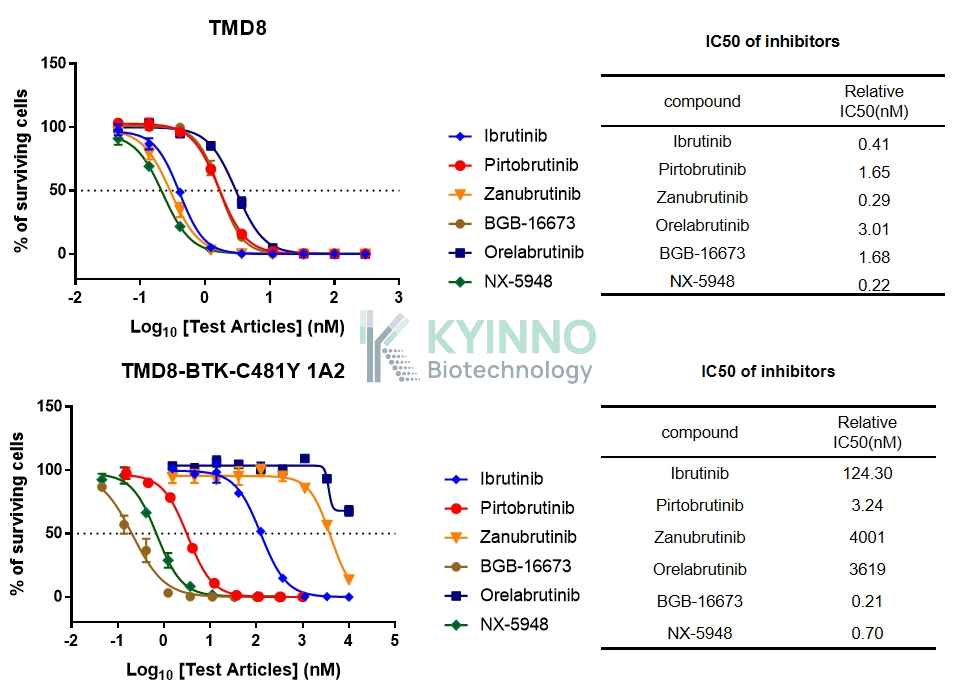
Figure 3: Characterization of dose-response curves for BTK inhibitors on TMD8 and TMD8-BTK-C481Y-KI cells.

Cell Resuscitation

  1. Prewarm culture medium (RPMI1640+10% FBS)in a 37°C water bath.
  2. Thaw the frozen vial in a 37°C water bath for 1-2 minutes.
  3. Transfer the vial into biosafety cabinet, and wipe the surface with 70% ethanol.
  4. Unscrew the top of the vial and transfer the cell suspension gently into a sterile centrifuge tube containing 9.0mL complete culture medium.
  5. Spin at ~ 125 × g for 5-7 minutes at room temperature, and discard the supernatant without disturbing the pellet.
  6. Resuspend cell pellet with the appropriate volume of complete medium and transfer the cell suspension into a T25 culture flask.
  7. Incubate the flask at 37°C, 5% CO2 incubator.
  8. Split saturated culture 1:3-1:4 every 2-3 days; seed out at about 1-3 × 10⁵ cells/mL.

Cell Freezing

  1. Prepare the freezing medium (70% RPMI-1640 + 20% FBS + 10% DMSO) fresh immediately before use.
  2. Keep the freezing medium on ice and label cryovials.
  3. Transfer cells to a sterile, conical centrifuge tube, and count the cells.
  4. Centrifuge the cells at 250×g for 5 minutes at room temperature and carefully aspirate off the medium.
  5. Resuspend the cells at a density of at least 3×10⁶ cells/mL in chilled freezing medium.
  6. Aliquot 1 mL of the cell suspension into each cryovial.
  7. Freeze cells in the CoolCell freezing container overnight in a -80°C freezer.
  8. Transfer vials to liquid nitrogen for long-term storage.

References

  1. Woyach JA, Furman RR, Liu TM, et al. Resistance mechanisms for the Bruton's tyrosine kinase inhibitor ibrutinib. N Engl J Med. 2014;370(24):2286-2294. doi:10.1056/NEJMoa1400029.
  2. Burger JA, Tedeschi A, Barr PM, et al. Ibrutinib as initial therapy for patients with chronic lymphocytic leukemia. N Engl J Med. 2015;373(25):2425-2437. doi:10.1056/NEJMoa1509388.
  3. Bond DA, Woyach JA. Targeting BTK in CLL: beyond ibrutinib. Curr Hematol Malig Rep. 2019;14(3):197-205. doi:10.1007/s11899-019-00512-0.
Please enable JavaScript in your browser to complete this form.